


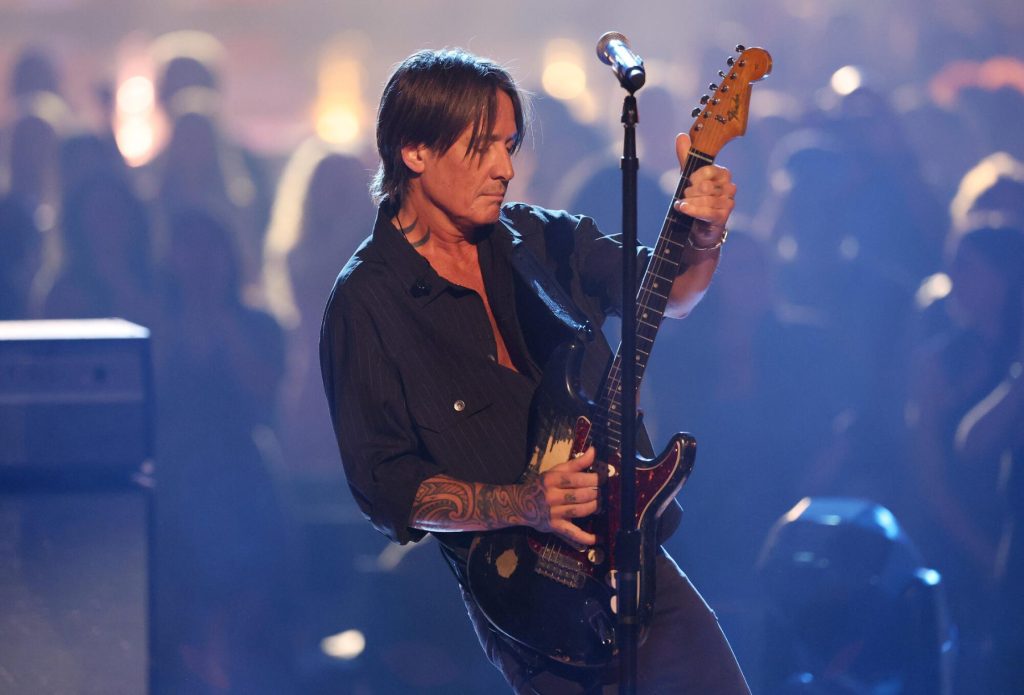
“It’s just being in the zone, isn’t it,” Keith Urban answers when asked what being in a flow state means to him and why he used the term as the title for his new album of yacht rock covers. “It’s that beautiful dichotomy of completely present and completely lost to the moment, where you’re a participant and observer so perfectly balanced that you’re neither.”
That ultra-Zen description might not be how many folks would identify listening to the 10 remakes of classic soft rock tunes from the ‘70s and one original on Flow State, available now, but hear Urban out and it starts to make a little more sense. “We have the want to have this feeling in common: Blue skies and a little bit of a breeze and no worries, man,” he continues. “We all want to have just a moment of exhale. I think everybody wants that at some point in their day, their life.”
To be sure, listening to Urban’s tasty versions of such tunes as Seals & Crofts‘ “Summer Breeze,” Player’s “Baby Come Back,” Stephen Bishop’s “On & On” and Ambrosia’s “How Much I Feel” is sure to lower anyone’s blood pressure.
What began as a fun lark to test out his new studio — Urban bought the old Tracking Room Studio in Nashville, renaming it the Sound — became a full-fledged project under the guidance of producer Dann Huff. “It was just to break in the studio. What took me by surprise was how much it became my next album,” Urban says.
As they worked up the tracks, Huff even posited that elements of these songs had been present in Urban’s songcraft all along and was why this music flowed so easily out of Urban. “One of the sessions he said to me, ‘I feel like I found one of the biggest missing pieces of how you make music,’” Urban recalls. “He said, ‘I always [questioned] how you come up with melodies for things like “Kiss a Girl” and those sorts of songs. It comes from this. This genre is probably deeper in your DNA than even you realized.’ That is why it sounds so organic to what I do, because it’s already in so many of the songs that I write anyway.”
(Yacht rock and country music together seems to be having a moment: Lady A’s Charles Kelley is hosting Y’all Aboard, a limited series on SiriusXM’s Yacht Rock channel with such guests as Little Big Town, Trisha Yearwood and Richard Marx).
In May, Urban talked to Billboard about diving into yacht rock, picking his collaborators and if there will be a volume 2.
How did you pick the songs for the project?
I choose songs based on my vocal ability. And some of those guys are beast singers. Kenny [Loggins’] range is insane. Mike McDonald’s range is insane. Some of David Pack with Ambrosia’s range, the same. I chose the [Ambrosia] one I could sing, “How Much I Feel” versus “You’re the Only Woman.” So, there’s songs I didn’t choose because they just didn’t fit what I do.
Will there be a second volume? Because I’m sure because Christopher Cross would like a word. He and Kenny are the notable omissions here.
100%. If people like this record and there’s any reason to do a second one, I literally have the 10 songs picked out already.
How’d it come together?
The thing about when you’re doing original music, the heaviest lifting — unless the demo is full of great hooks and arrangements — is you got to come up with all that in the studio. That’s usually the most time-consuming part of making records for me. When I was home, singing all these yacht rock songs, I was like, “Oh, these arrangements are bulletproof. They’ve already done the heavy lifting.” I mean, first, was that they suited me, but secondly, it was that the arrangements were bulletproof.
A lot of them start very much like the original and then you go off in your own direction. How responsible did you feel? Feel to keep them close to the original.
I think I probably originally had the idea to honor the originals almost to a T. Dann was the one who said, “Let’s find places to make it yours.” And then I realized as soon as I start singing, it sounds like me anyway.
One of the areas I’ve always found that I like to go off script, if you will, is at the end of songs. People who grew up in that era where there were fades know all about turning the volume up because this amazing thing happened right at the very end of the fade — you could just hear the guitarist do something that was so cool, because typically the session players figure, “We’re out by now, they’re not going to use all this, we’re just now playing for playing’s sake.” That’s when all the cool stuff starts happening. I’ve found so many times on my records, the reason why “Stupid Boy” and some of those [songs] had these long outros is what the band would do at those periods was really cool, and I didn’t want it to not be heard.
Were there any songs that it broke your heart not to be able to include?
I’d love to have been able to do “What a Fool Believes,” but I don’t sing like Michael McDonald. Nobody does. [Toto’s] “Rosanna” would have been fun. I don’t have that voice.
Michael McDonald does sing here on the one original, “We Go Back,” which you wrote during the pandemic with Breland, Sam Sumser and Sean Small, and imagined having Michael on it. How do you get Michael McDonald on a record?
I knew Darrell Brown had produced a record on Michael, so I called Darrell and I said, “I’m so respectful of Michael. Let me play you this song and you tell me if you think it’s something Michael might like.” Darrell really loved it. Then I said, “Can you now call Michael for me and see if he’d be up for me calling him?” I love to give artists every out before they’re in an embarrassing position. Michael’s like, “Give him my number.” I sheepishly called Michael, and he’s like, “Send me the song, I’d love to hear it.” I sent it to him, and he just pretty much immediately goes, “I love this. When do you need it?”
Little Big Town is also on here on “Magnet & Steel.” How did that come about?
As soon as I heard the song, I’m like, “This is Little Big Town all day long.” The full weird story about all of that just recently is [guitarist] Waddy Wachtel is a good friend of mine, and he plays in Stevie [Nicks’] band. I sent Waddy the record, he played it for Stevie, and he sent me a text: “Stevie’s very angry that she wasn’t asked to sing on the song with you.” I’m like, “Oh my god, that’s fantastic!” [Laughs.] So, of course, she’s listening to Little Big Town sing her part that she originally did [on the original].
Have you gotten any other reactions from any of the artists who cut the songs originally?
Somehow David [Pack] heard that we had cut an Ambrosia song, and he got hold of somebody to get his number to me. I ended up calling him. So, I sent him “How Much I Feel.” He called me and was just glowing about the song, and [asked],”What else have you got on the record?” I said, “‘On and On.’” He goes, “Oh, please send me that,” and later that afternoon I get this voice text recording from Stephen Bishop. Going, “Hey, man, that’s an amazing version of my song.” I’m like, “Holy shit, what’s happening?” David then did the same thing with Robbie Dupree [and “Steal Away.”]. Next thing, I’m getting a text through [publisher] Barry Coburn from Robbie Dupree saying, “Man. That’s awesome. Thank you so much.”
Many of the songs here start very faithful to the originals and then veer into different territory instrumentally — but none so much as Bread’s “Guitar Man,” where you and John Mayer go off into a long instrumental guitar break. Did you do that in person?
I really wanted to, but no. I sent him stuff. He just bought a studio, too, he bought Henson Studio in Los Angeles. When I sent him the song, I’d already done all my guitar part, so it helped because he was able to respond to my playing. We did get to have a conversation, but it would have been nice to do it together.
What are you going to do with your new studio? Do you go in every day?
Not every day, but I go pretty regularly. Even just popping in like I’ll just take my laptop down there and just sit in the front room, do some emails. I’ll go down on the weekends when it’s closed and play drums for a while and putter around. It’s just my little man cave, basically.
But you’re not running it as a commercial studio where anyone can book it, right?
Morgan Wallen just shot a tea commercial there, and then Ella Langley did some string overdubs for her record, and Michael Bublé just did a bunch of his stuff there. What I base it on is that I have to know somebody who’s calling. Even if it’s just the engineer. I look at it like — it’s my house, and if I know you, you can bring a friend, but you got to be there to vouch for your friend in case they trash the furniture. You’ll be responsible for that. It can’t be all strangers.
So many has been the time I’ve gone in there, and it’s just empty, and it’s kind of heartbreaking — because it’s a hell of an overhead. And I’d like to see it being used, but I also need to know it’s spontaneously available. So, I’m trying to find the balance.
Finally, speaking of yachts — are you a boat person?
I’m an ocean person. I grew up on the ocean like most people do in Australia. Most of the populations clinging to the edges [of the country], not much in the middle. Going to the beach was a huge part of my childhood. If I can choose between mountains and oceans and deserts and forests and various things as a getaway into nature, I’d always choose the ocean.



Comentarios