

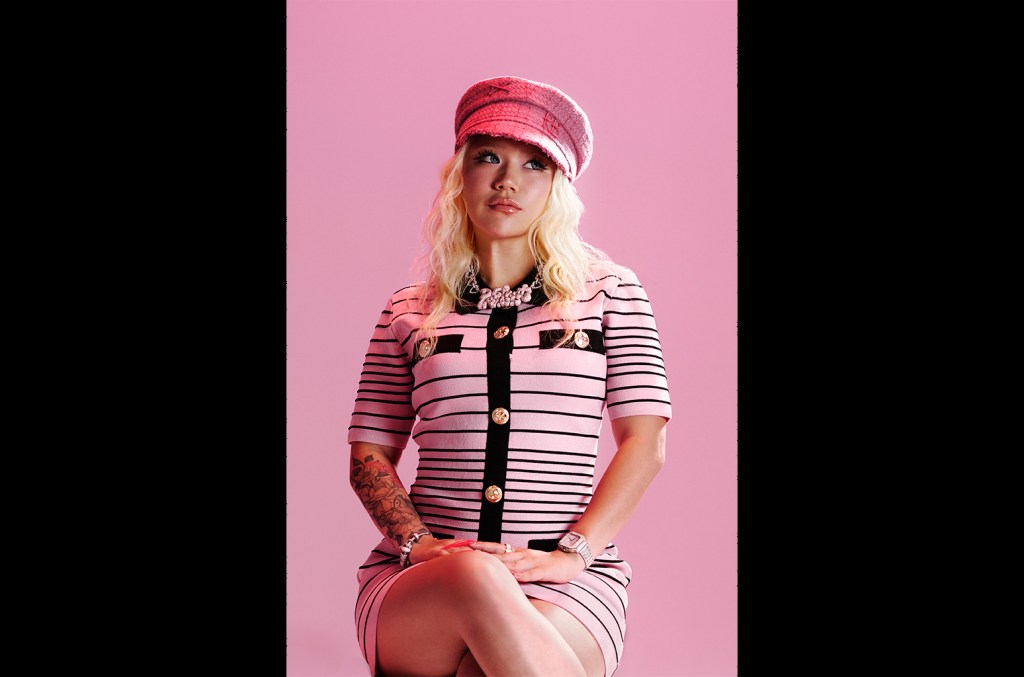
LANA sat down with Billboard Japan for the latest installment of its Women in Music interview series. The initiative launched in 2022 to celebrate artists, producers and executives who have made significant contributions to music and entertainment and inspired other women through their work, following the footsteps of Billboard’s annual Women in Music honors. This series featuring female players in the Japanese entertainment industry is one of the highlights of Japan‘s WIM project.
Explore

See latest videos, charts and news
On June 9, a one-night-only stage event co-presented by Billboard Japan Women in Music and Spotify EQUAL — the global program launched in 2021 to expand opportunities for women artists and creators — is set to take place at SGC Hall Ariake in Tokyo. Ahead of the show, the 22-year-old rapper spoke with writer Shiho Watanabe about what it means to work as a woman in the Japanese music industry, and the impact she believes women can have on the scene.
Girls inspired by your fashion, makeup, nails, and personal style flock to your shows and it’s staggering to see how much support you have from women your own age. Do you notice common problems everyone seems to share, by sensing what your fans send your way, or through time spent with your friends?
I think at the root of it all, there’s this problem of not knowing how to deal with anything. And honestly, everyone is just so lonely. There’s nobody teaching young people how to sit with that loneliness or tend to their inner world. I really wish schools would teach that kind of thing. Financial literacy, too, and the benefits of therapy. I think there needs to be an environment where people learn who they are and who they want to be. I think some kids end up becoming these “monsters” because they never had that. That’s actually why I write songs — to teach what I wish someone had taught them. Simply put, that’s it.
Do you go to therapy yourself?
Yeah, sometimes. I’m always looking for the right fit, and practicing how to be alone with myself, how to endure solitude. I’ve come to think of life as having four waves a year: good times, bad times, cycling over and over. When I’m happy, I try not to let that feeling slip away. When I’m low, I hold onto the warmth of other people. Either way, I remind myself that no emotion lasts forever. I really believe that if people could develop that kind of coping ability, they’d become so much stronger. For me it’s like, the reason I have today is because I’ve never stopped facing my solitude and loneliness.
Do you talk about these things with your friends?
I do. Watching people around me, I’m always struck by how much courage it takes for someone to take even a single step forward.
There must be many fans who tell you that going to one of your shows changed them.
I don’t want to sound arrogant, but if someone feels that way, I want them to hold onto it. And I want them to remember in their daily lives that they’re always the ones who get to choose. Happiness and pain live right next to each other, and even if I look like I’m shining up on stage, I also have hard stuff going on behind the scenes. So I guess it’s hard to resist diamonds that shine even while they’re being chipped away.
How much time do you spend on social media?
None at all. I have no idea what people are saying about me.
Is that something you worked out over the course of building your career?
Yes, I think I’ve changed a lot. Things that were said to you in the past keep echoing in your head (when you’re too online). But now I’ve stopped pretending to be nicer than I am. At the same time, I know I need to tighten up where I’m actually lacking, and feel like I’m finding the right balance.
In 2025 you performed solo shows at the historic Nippon Budokan and arenas within a year, which is a rapid evolution as an artist. Does it feel like your sense of purpose is getting clearer?
Yeah. At the end of the day, my job is to deliver songs. This year I feel like I’m coming back to that starting point. No matter how many things I take on or how extravagantly I dress it up, what’s being asked of is my skill and my soul.
What you carry on the inside.
Exactly. Once I understood that, I feel like I’ve been doing what I need to do with real seriousness. To the point where I can hold my head high and say I haven’t made a single wrong choice up to this point. I’m living the right way, and growing older the right way. I think I’m pretty pure, actually.
Your vlog shows just how hectic your days are.
It’s “tonkotsu.”
What do you mean by that?
Like eating tonkotsu (pork broth) ramen, I’m always stuffed. I come at everything at full calories, all the time. I barely have room for memories. I think if I got even a little detached from that, (LANA would) probably change, and that scares me. So maybe just being myself, without even realizing it, is what ultimately comes through to the audience.
Your stage with female rapper Elle Teresa at the hip-hop festival POP YOURS in May was a major talking point — you released the collab “Konna Hi wa” and debuted it live together.
Elle is someone I’ve been listening to since I was a teenager, so first of all, I’m just grateful. And going into a collaboration that big was scary, too. But even with all the speculation out there, I think the choice we made to take each other’s hand was something beautiful. I feel like we were able to make a statement to the people who came to the show, and to those who weren’t happy about (our collaboration) — a real, “How about that?”
So the reception from fans and hip-hop listeners wasn’t uniformly positive, and there were negative voices, too. You’ve collaborated with Awich, 7, MaRi, and also brought together young female MCs for your “Oi Ran” project. It feels like you’ve always made a point of standing alongside other women in rap. The costumes you and Elle wore at POP YOURS with the big heart-shaped wings were really cute, by the way.
That was precisely the vibe I was going for — a show that feels like a fashion runway. After it was over, I thought that maybe doing a song with Elle was the most powerful message I could send to everyone.
Seeing you two joining hands gave the audience so much energy.
When you really think about it, it’s kind of wild. I was hit by it myself. Women from different corners of the scene who don’t usually cross paths, walking a runway together… that’s not something you really see in Japan.
Elle and I had exchanged greetings a few times before, but we’d never really talked. This time it started with me saying I wanted to make a song together, and then we were like, “Let’s hang out.” We went shopping and grabbed food a few times. Actually spending time with her, I realized she’s a different kind of “gyaru” (confident, stylish, unbothered young woman) than me. I’m more of a rough-around-the-edges type, but Elle is the kind who has built everything she has by just being fully herself.
As a woman working in music, and specifically in hip-hop, have you ever been on the receiving end of comments like, “You can’t do that, you’re a girl,” or felt uncomfortable because of biased views on gender?
It’s everywhere in daily life. “A woman can’t handle her drinks.” And expressions that basically frame women as something men are entitled to have. But rather than feeling hurt by that, my reaction is more like, “Fine, I’ll drink twice as much.” Or, “Come at me, then.” I don’t take it negatively, but more like, “I’ll do it twice as hard.”
Maybe that attitude is why you draw in male fans, too.
I do feel like my male listenership has been growing lately.
This is my own thought, but in a previous interview in this series, I said something like, “If more women become rappers, maybe more women will enter parliament, too.” There are still men who think “I’m not taking orders from a woman,” but if more men are being inspired by artists like you and Awich, maybe that dynamic will start to shift.
I get that. I can see more women emerging who are skilled at leading from a position of authority, or at getting through to men and being understood by them.
You debuted as an artist at 18. Have you ever felt that women are underrepresented in the industry?
Absolutely. There have been actual shoots where there were no women on set, and I’d be in a somewhat revealing outfit with a crew of men looking at each other going, “How are we supposed to frame this?” I really believe that if there were more women creators in those spaces, the finished work would be so different. And it’s not that I’ve given up, but there are people who are completely oblivious to how few women there are, and they just don’t notice. Within that reality, when I find someone who resonates with the same awareness I have, I start thinking, “How can we do things together?” That’s both meaningful and efficient. Awich is like that, and so is Elle. When women who share the same awareness come together, I think they give everyone courage, so that’s something I want to keep doing.
You’ll be performing at Women In Music — EQUAL STAGE, an event centered on women’s empowerment. What kind of show are you planning?
I want to put together something that girls can really look up to. But I also think that just being myself is what makes that come through. There will be people seeing me live for the first time, so I want to pack in LANA’s essence and deliver it full-force. Banging. [Laughs] By the time it’s over, I want everyone in that room to be completely under my spell.
—This interview by Shiho Watanabe first appeared on Billboard Japan

Comentarios